
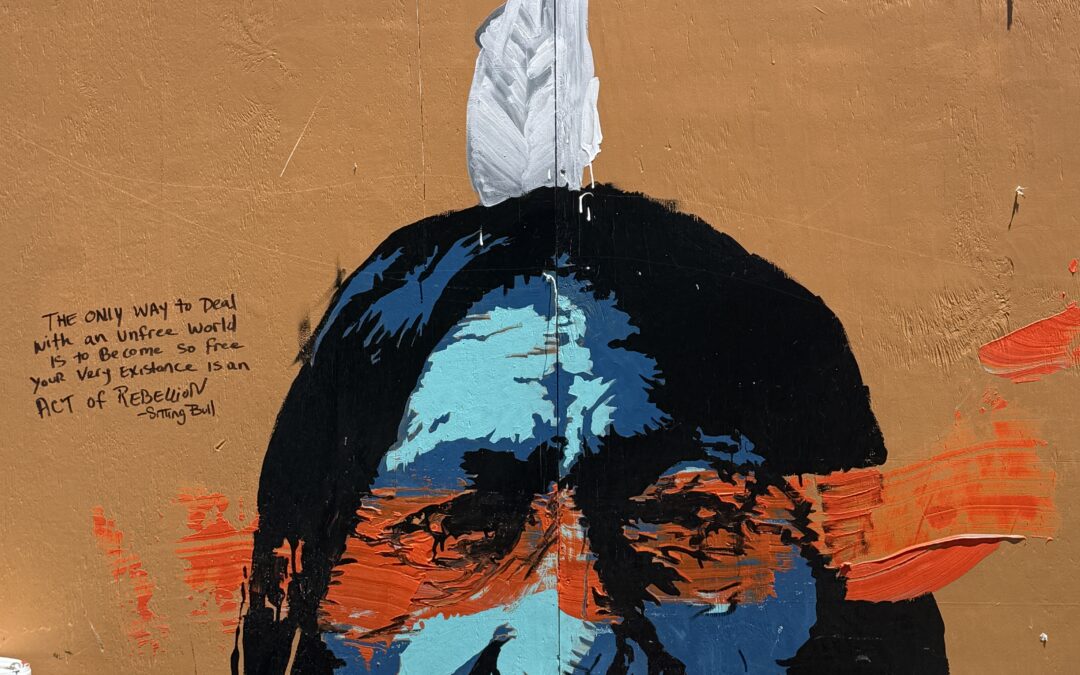
Photo of a painted truck in Santa Fe. The quote appears in the artwork as attributed to Sitting Bull, though it is more commonly attributed to Albert Camus.
There is a quote I have been sitting with:
“The only way to deal with an unfree world is to become so absolutely free that your very existence is an act of rebellion.”
But how do we become free?
I have been asking myself that for a long time.
What is freedom? I suppose it is different for everyone. There is physical freedom, mental freedom, and spiritual freedom. There is the freedom to move through the world, and then there is the deeper freedom to be who we truly are.
Can one be free while sitting in a jail cell? Can one appear free on the outside and still be imprisoned within?
What I have come to realize is that becoming truly free is an inside job. And the first step is becoming deeply aware of what actually imprisons us.
So what is it?
The Prison of Identification
I believe it is our identification with the ego personality.
The ego itself is not the prison. Identification with the ego is the prison.
It is the conditioning, the constructs, and the protective mechanisms that keep us from being in touch with our true nature — our soul, our true Self, our deeper Being. That is the jail cell. And with any jail cell, the way out is not to destroy the cell; it is to find the key, open the door, and walk out.
So I am not suggesting that, in order to become free, we need to kill the ego. No. We need to know the ego. We need to understand how it operates, the mechanisms that keep it in place, and why it is there in the first place. We need to see how it has tried to protect us, often from a very young age, so that we are no longer automatically and unconsciously run by it.
Fear as the Prison Guard
And fear, I believe, is often the prison guard.
Fear of not belonging. Fear of being rejected. Fear of being too much. Fear of being different. Fear of being seen. Fear of being alone. Fear, ultimately, of not surviving.
As children, belonging is survival. We learn very early how to adapt ourselves in order to stay connected, loved, approved of, or safe. We learn what parts of ourselves are welcomed and what parts seem to threaten our belonging. So we begin to shape ourselves. We hide. We perform. We achieve. We stay quiet. We become good. We become pleasing. We become small.
And over time, these protective mechanisms become so familiar that we believe they are who we are.
A central issue is that we become identified with the personality. We think it is who we are, forgetting our true Self. But when we begin to know the personality, we can consciously tune into other possibilities and choose a different response — one not based on the past or on the assumptions we have carried about ourselves.
When we can observe the ego at play, recognize the limits it has placed upon us, and disengage from identifying with it, we begin to unlock the door to the cell.
The Key Is Within Us
The jailer is not ultimately outside of ourselves, although we live in a world that often encourages us to place our authority outside ourselves. Through culture, family, institutions, religion, education, and social expectations, many of us have been taught to distrust our own inner knowing. We have been taught that someone else holds the key: someone else must tell us who we are, what we are allowed to believe, what we are capable of, and how we should live.
But the key is within us.
We simply need to understand the mechanics of the lock and cultivate the courage to walk through the open door.
This is what I mean by sovereignty.
Not a hard independence or separation from others, but a remembering of our direct connection to Source, God, Divine Love, unlimited intelligence, Life itself — whatever words feel true to you. Sovereignty is the knowing that our deepest authority does not come from outside of us. It comes from the quiet, living truth within.
Each person has the capacity to receive inspiration. Each person carries a divine nature, even if we have forgotten, learned otherwise, or been taught to doubt it.
So perhaps freedom is not about becoming someone new.
Perhaps freedom is remembering what has never actually been imprisoned.
It means remembering who we truly are beneath all the programming, masks, and constructs of the ego. It means seeing how these patterns may once have served us by keeping us safe, while recognizing that they are no longer serving us now.
You have outgrown the cage.
It is time to walk free.
So where do you feel imprisoned, stuck, constrained, or unable to move beyond a habit or belief about yourself? What is one thing you are absolutely certain is true about yourself that may actually be keeping you from your deepest desire or purpose?
A Personal Example
Let me give you a personal example.
My ego personality would have me believe that I am inherently flawed, unworthy, and inconsequential. Because of that, I have often approached opportunities believing my contribution is not worthwhile, or that I am better off staying small and unheard. This has created a schism between me and my natural gifts and my desire to serve.
As long as that belief remains intact, I become reluctant to fully thrive. I make myself invisible.
Once I became aware of the mechanism — stay small to stay safe — and the underlying belief that I am flawed, I could begin to observe it whenever it offered its familiar advice:
Procrastinate so you do not prove you are flawed.
Stay quiet.
Do not take up too much space.
That person’s needs matter more than yours.
With awareness, I can choose whether to believe the ego or recognize that it is simply the personality with which I had become identified.
From this objective distance, I can make different choices. I can care for my own needs. I can reconnect with my true Self and my gifts. I can express myself with the knowing that my voice matters and that my expression has value.
Perhaps you relate to this example. Or perhaps your ego has a different flavor.
Maybe it tells you that you are too much.
Maybe it tells you that you must achieve in order to be loved.
Maybe it tells you that your needs are inconvenient.
Maybe it tells you that your sensitivity is a problem.
Maybe it tells you that your longing is unrealistic.
Either way, there is a common human tendency to forget our true Self — our inherent beauty, love, wisdom, and Beingness — when we become identified with personality. Ironically, the ego is often trying to protect us from the very depth and power of who we truly are.
Becoming deeply familiar with the parts of ourselves that were formed to protect us, while taking the time to inquire into our true nature, is one way we begin to free ourselves.
Practices of Remembering
And taking time for ourselves is essential in this day and age, when so many people are easily distracted. To become truly free, we need to cultivate the capacity to turn inward rather than depend upon constant external stimulation or outside authority. We need to learn to trust ourselves again.
Meditation, breathwork, creative expression, intuitive painting — these are not simply techniques for self-improvement. They are ways of remembering.
They help quiet the monkey mind that seeks to keep us distracted and dependent. They help us listen beneath the noise. They help us feel what is true. They help us return to the deeper Self that has been there all along.
An Invitation to Breathe & Create
This is one of the reasons I created Breathe & Create.
It is a space to step away from the distractions of the outer world and give yourself the gift of your own presence. A space to breathe, soften, listen, create, and remember. Not to force an answer. Not to become someone else. But to spend time with yourself in a way that cultivates awareness, reconnects you with your inner authority, and gently opens the door to what is already true within you.
Perhaps this, too, is an act of rebellion:
To pause.
To listen inwardly.
To remember who you are.
To reclaim your own direct connection to life, love, creativity, and Source.
To become so rooted in your true Self that your very existence becomes an expression of freedom.